Running a Hotel on Khaosan Road: What the Travel Blogs Do Not Tell You
Khaosan Road has a reputation. Backpackers, bucket drinks, noise until 3 AM, and the occasional tourist doing something regrettable on a tuk-tuk. Every travel blog either romanticises the chaos or warns you to avoid it entirely. Neither version is useful if you are trying to run a hotel here.
We opened Bud Brew on a side street off Khaosan, in Bangkok's Phranakorn district, eighteen months ago. Not by accident. On purpose. Here is what operating on this street actually looks like, and why we would pick the same location again.
The Neighbourhood Is Not What You Think
The travel blog version of Khaosan is a two-block stretch of bars, massage parlours, and pad thai stalls selling to tourists. That stretch exists. It is about 400 metres long. The rest of Phranakorn is one of the most historically rich neighbourhoods in Bangkok.
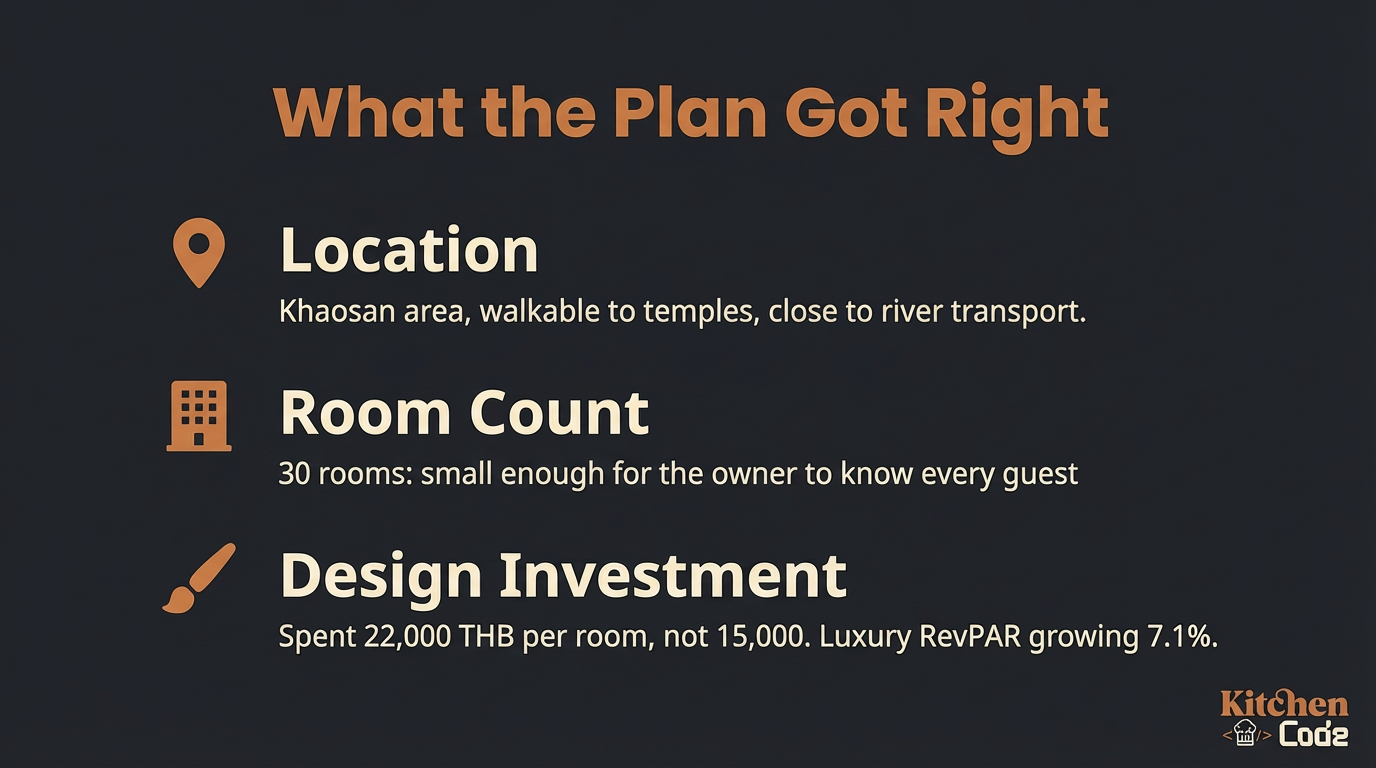
Walk five minutes in any direction from the party strip and you are in a completely different city. Wat Bowon, one of Bangkok's most important temples, is 200 metres from our front door. The Grand Palace is a 15-minute walk. Wat Pho is 20 minutes. The Chao Phraya river piers are 10 minutes. Phranakorn is the old royal district of Bangkok. The temples, the architecture, the street food markets that serve locals, not tourists. All of it is here.
Our guests do not come for the party strip. They come because the location puts them inside Bangkok, not in a sanitised tourist zone. They want to walk to the temple in the morning, eat som tam from a street cart at lunch, drink craft beer on our rooftop at sunset, and fall asleep looking at temple spires from their window. That guest exists in large numbers, and most hotels on Khaosan are not designed for them.
The Operating Reality
Noise management is a real operational problem. Not from the street. From our own guests. The same traveller who wants a peaceful boutique experience at check-in sometimes comes back at midnight after three hours on Khaosan Road proper with a different set of priorities. Managing that transition is a hospitality skill that no training manual covers.
Our solution was simple. The ground floor is the bar. The rooms are on floors two through four. The bar closes at 1 AM on weekdays, 3 AM on weekends. Rooms have proper soundproofing. The rooftop closes at midnight. Guests who want the late night go out on Khaosan. They do not bring Khaosan back to the hotel. That boundary took about four months to establish with signage, gentle enforcement, and one very honest conversation with a guest from Melbourne at 2 AM on a Tuesday.
Security is straightforward. Khaosan is one of the most policed areas in Bangkok. Tourist police have a permanent station on the main strip. Petty theft exists but is not worse than any other tourist area in any major city. We have never had a serious security incident. The area's reputation is louder than its actual crime rate.
Staffing is easier than we expected. Most hotel employees in Bangkok live on the outskirts and commute. Phranakorn is well connected by bus and river ferry. Sam Yot MRT station is a 10-minute walk. We have lower turnover than comparable properties in Sukhumvit or Silom, partly because the commute is easier and partly because the team genuinely likes working here. The neighbourhood has character. That matters to staff as much as it matters to guests.
The Guest Profile Surprise
We expected backpackers. We got a different guest entirely.
Our average guest is 28 to 40 years old. Travelling as a couple or in a small group. They have been to Bangkok before, or they have done enough research to know they do not want to stay in the Sukhumvit corridor. They care about where they sleep. They are willing to pay 1,600 to 3,400 THB per night for a room that feels intentional.
This guest does not want a capsule hostel. They also do not want a 300-room chain hotel with a lobby that looks like an airport lounge. They want something in between. A place with personality. A place where the owner might be sitting at the bar. A place where the staff knows their name by day two.
That is a growing segment. The global boutique hotel market is at $26.68 billion and heading to $40.26 billion by 2030. The traveller who chooses a 30-room property with themed rooms over a Marriott is not a niche anymore. They are a market.
What the Location Actually Gives You
Foot traffic. Actual people walking past your door who do not know you exist yet. In a hotel business that spends 15 to 25 percent of revenue on OTA commissions to get discovered, free visibility from pedestrian traffic is worth more than most operators calculate. We get two to four walk-in enquiries per day. Not all of them convert, but the ones that do cost us zero in commission.
Content. Khaosan is photogenic. The temples are photogenic. The street food is photogenic. Our rooftop overlooking Wat Bowon at sunset is photogenic. Every guest produces organic content without us asking. Our Instagram following grew from zero to 4,000 in the first year, almost entirely from guest tags and stories. We did not hire an influencer. The location did the work.
Repeat visitors. Bangkok is a repeat destination. Travellers come back. And the ones who stayed in a boutique property in Phranakorn and had a good experience do not go looking for alternatives on Booking.com next time. They message us directly. Direct bookings at 22% and climbing. Every percentage point we gain reduces our effective commission rate. That flywheel started because the location creates memorable stays, and memorable stays create direct bookings.
Would We Do It Again
Yes. Without hesitation.
Not because Khaosan is perfect. The street has problems. It is loud. It attracts a segment of tourism that does not align with our product. The local government has talked about "cleaning up" the area roughly once a year for the past decade, creating periodic uncertainty about regulations and street vendor policies.
But the location advantages outweigh every disadvantage. Proximity to Bangkok's most visited landmarks. A neighbourhood with genuine character. Foot traffic that reduces customer acquisition cost. A guest profile that values what we are building. And a story that writes itself.
Every property has a location story. Most of them are about convenience or proximity to a convention centre. Ours is about opening a boutique hotel on the most misunderstood street in Bangkok, and finding out that the guests we wanted were already looking for exactly what we built.
Everything we build starts because something broke. On Khaosan, what was broken was the assumption that this neighbourhood could only support bucket-drink hostels. The neighbourhood was ready for something different. We just had to be stubborn enough to build it here.